
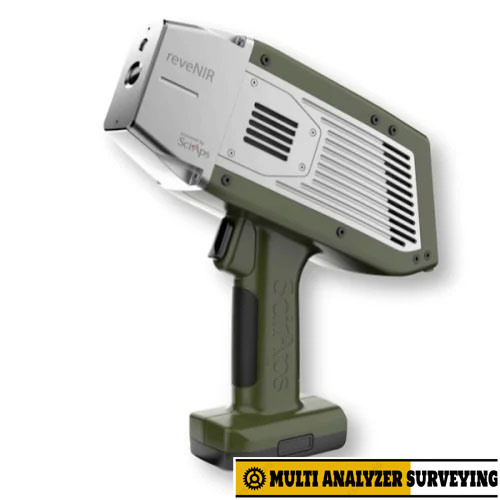
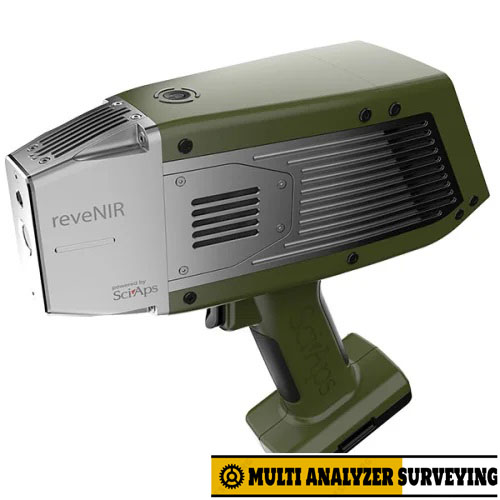
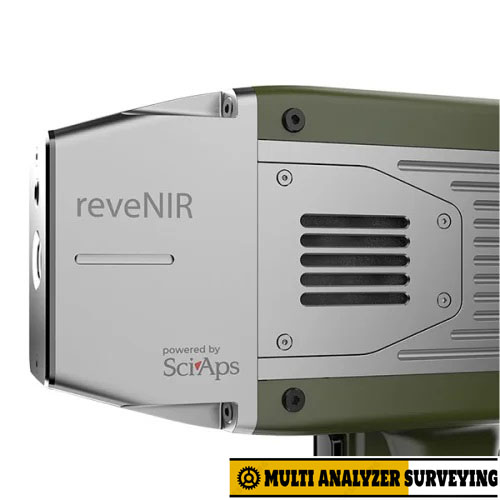
Sciaps reveNIR Portable Handheld Analyzer
What does it measure?
Unlike an XRF analyzer, which primarily tells you elemental composition, reveNIR measures spectral/mineralogical characteristics. This makes it particularly useful for recognizing minerals and alteration zones associated with mineral deposits.
SciAps specifically highlights applications involving:
- Epidote
- Calcite
- Chlorite
- Al-OH minerals
- Mg-OH minerals
- Illite and alteration characteristics
- Fe³⁺-related spectral information
It also calculates spectral scalars such as Al-OH, ISM (Illite Spectral Maturity), Mg-OH and Fe3t, which can provide additional vectors toward potential mineralization.
How it works
- The instrument illuminates the sample.
- It records the reflected light spectrum from 350–2500 nm.
- Spectral absorption features are compared against mineral libraries.
- The instrument identifies or predicts mineralogical characteristics.
- Results can be stored with location/data information and exported or uploaded to the cloud.
This allows a geologist to make rapid decisions in the field rather than waiting for laboratory mineralogical analysis.
Main applications
Mining & mineral exploration
- Geological reconnaissance
- Drill-core logging
- Alteration mapping
- Pathfinder-mineral identification
- Exploration vectoring
- Rapid field characterization
Core scanning
An industrial version can be configured for core-scan mounting, making it useful for systematic drill-core analysis rather than only handheld spot measurements.
reveNIR vs portable XRF
| SciAps reveNIR | Portable XRF | |
|---|---|---|
| Primary measurement | Mineralogical/spectral | Elemental |
| Typical output | Minerals & alteration | Element concentrations |
| Spectral range | 350–2500 nm | X-ray energies |
| Lithium | Indirect/mineralogical | Elemental measurement depends on instrument |
| Alteration minerals | Excellent application | Limited |
| Metal grades | Not its primary purpose | Excellent application |
| Drill-core logging | Very useful | Useful |
| Exploration vectoring | Very useful | Useful |
| Best used with | XRF + geology + assays | NIR + geology + assays |
SciAps positions reveNIR as complementary to portable XRF, rather than a replacement.
Important distinction
The reveNIR is not the same technology as the SciAps Z-series LIBS analyzers. The Z-series measures elemental emissions using laser-induced breakdown spectroscopy (LIBS), while reveNIR uses Vis-NIR reflectance spectroscopy.
The reveNIR was also developed as a modern replacement for the discontinued ASD Halo, according to SciAps. It is approximately 50% smaller and 2 lb lighter than the original Halo.
In short: the SciAps reveNIR is best thought of as a field mineralogical analyzer for geologists—particularly valuable for alteration mapping, mineral identification and exploration vectoring, while XRF/LIBS instruments are better suited to determining elemental composition.
If you’re evaluating it for purchase, the next useful step is a reveNIR vs ASD Halo vs TerraSpec/FieldSpec comparison, including specifications and typical applications.
Key specifications
| Feature | SciAps reveNIR |
|---|---|
| Technology | Vis-NIR reflectance spectroscopy |
| Spectral range | 350–2500 nm |
| Resolution | VIS: 3 nm; NIR: 8 nm |
| Weight | 4.5 lb / ~2.0 kg with battery |
| Battery | Up to 6 hours continuous use |
| Protection | IP54 |
| Wireless | Wi-Fi, GPS, Bluetooth |
| Libraries | 250+ exploration minerals included; custom libraries supported |
| Storage/reporting | On-device, PC and cloud |
| Core scanning | Industrial mounting option |
| Cloud | External libraries and real-time results |



There are no reviews yet.