
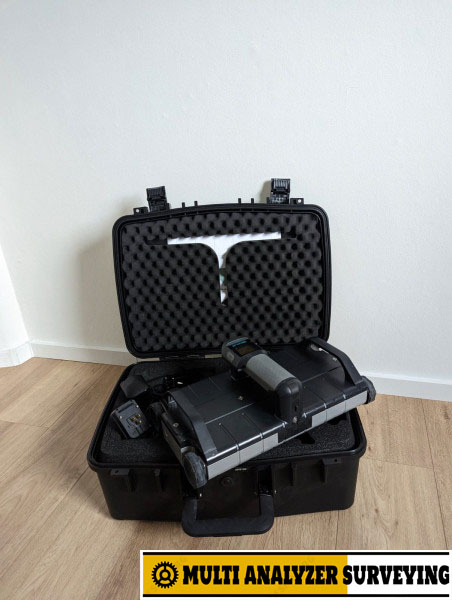
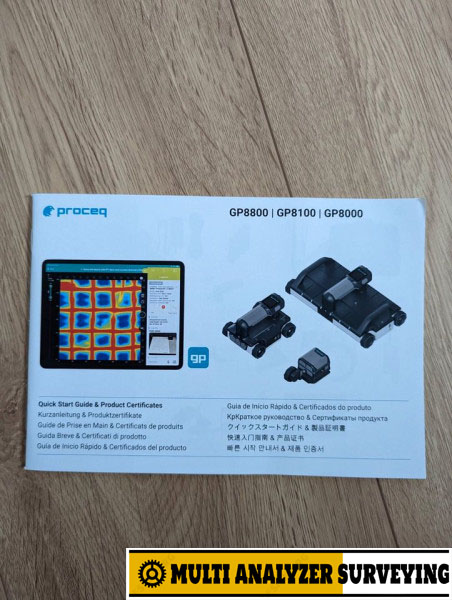
Proceq GP8100 Portable Concrete GPR Array
Key features
| Specification | GP8100 |
|---|---|
| Radar technology | Stepped-Frequency Continuous-Wave (SFCW) |
| Frequency range | 400–4,000 MHz |
| Antennas | 6-antenna array |
| Penetration depth | Up to 80 cm / 31.5 in* |
| Effective scan width | Approx. 25 cm |
| Scan rate | Up to 1,200 scans/s |
| Measurement modes | Superline Scan, Line Scan, Area Scan |
| Weight | Approx. 3.0 kg excluding battery |
| Dimensions | 41.5 × 22.5 × 13.2 cm |
| Battery | Removable 8× AA NiMH pack |
| Typical autonomy | About 3 hours; up to 8 hours with suitable power bank |
| Connectivity | Wi-Fi / USB-C |
| Guidance | Laser scan-direction and center-point guidance |
*Actual penetration depends strongly on concrete properties, reinforcement density and other site conditions.
Why the 6-antenna array matters
The GP8100’s main advantage is its array configuration. Six antennas simultaneously acquire six parallel scan lines. Proceq calls the resulting measurement a Superline Scan. This provides substantially denser coverage than manually pushing a single-antenna GPR over the same area.
The effective scan width is about 25 cm, and the manufacturer describes one Superline scan as equivalent to multiple conventional line scans, making the instrument particularly productive on large concrete surfaces.
Typical applications
- Rebar mapping and reinforcement layout
- Locating post-tensioning tendons/ducts
- Finding embedded pipes and conduits
- Checking concrete before drilling, coring or cutting
- Locating potential voids and anomalies
- Concrete structural assessment
- Inspection of bridge decks, slabs, walls and other concrete structures
- High-density GPR data collection for subsequent analysis
Data visualization
The GP8100 works with the Proceq GPR App on an iPad and can provide several visualization modes, including:
- A-scan
- B-scan / line scan
- Superline scan
- Migrated and non-migrated views
- Time-slice visualization
- 3D visualization
- Augmented Reality (AR)
Data can also be exported in formats such as JPG, PNG, DOCX, HTML and SEG-Y, with integration into Screening Eagle Workspace for reporting and data management.
GP8100 vs conventional single-antenna GPR
Main advantage: productivity.
A conventional single-antenna concrete GPR requires many closely spaced passes to build a detailed picture. The GP8100’s six-antenna array collects six lines simultaneously, so it is especially attractive when surveying large slabs, floors, walls or bridge decks where scanning speed matters.
One important trade-off is that the GP8100 is optimized around its array/superline workflow, whereas other Proceq GPR models can offer different frequency ranges or specialized configurations. For example, the GP8000 offers greater specified penetration depth, while the GP8800 emphasizes a different antenna configuration and cross-polarization capabilities.
In short: the GP8100 is best viewed as a high-productivity concrete GPR mapping system, rather than simply a handheld rebar locator.
If you’re evaluating it for purchase or inspection work, the next useful step would be a GP8100 vs GP8000 vs GP8800 comparison, including penetration depth, antenna configuration, scanning speed, applications and typical use cases.






There are no reviews yet.