
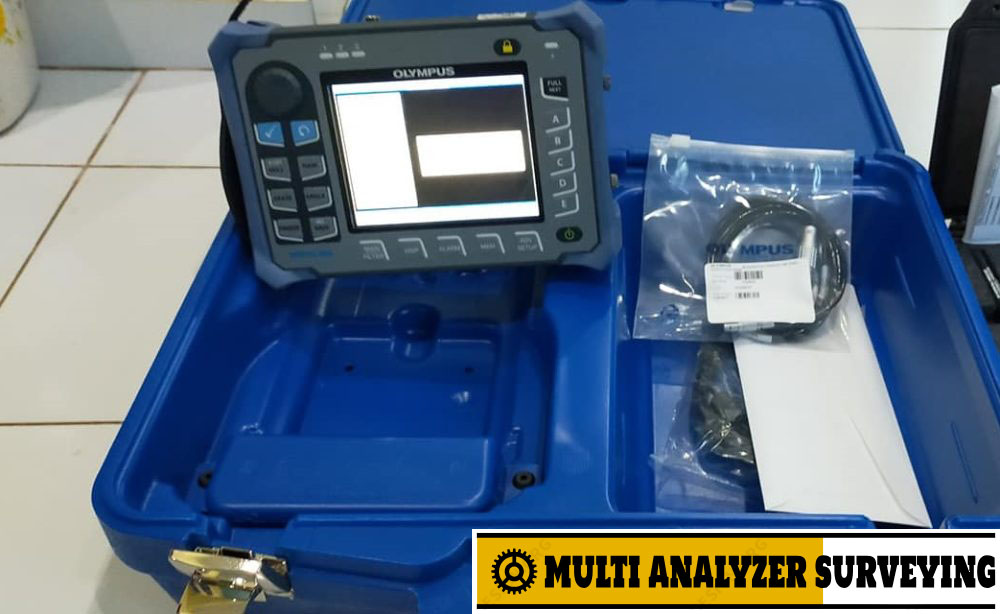
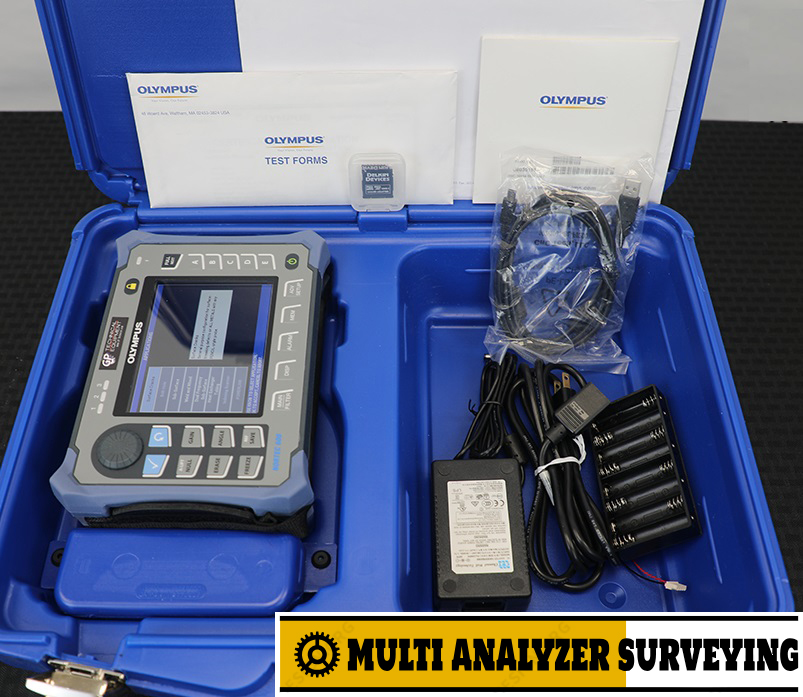
Olympus Nortec 600D Dual Frequency Eddy Current Flaw Detector
Key feature: Dual-frequency testing
The 600D is the dual-frequency version of the NORTEC 600 family. It can simultaneously inject two independent test frequencies (F1 and F2) and combine their signals using:
- F1 − F2
- F1 + F2
- Automatic true mixing
This is particularly useful for suppressing unwanted signals and separating defects from geometry, supports, deposits, or other background effects during tubing inspections.
Main specifications
| Specification | NORTEC 600D |
|---|---|
| Test frequency | 10 Hz–12 MHz |
| Gain | 0–100 dB |
| Phase rotation | 0–359.9° |
| Probe drive | Low / Medium / High — 2 / 5 / 8 V |
| Probe connections | 16-pin LEMO + BNC |
| Probe types | Absolute and differential |
| Display | 5.7-inch VGA |
| Battery life | Up to approximately 10 hours |
| Dimensions | 236 × 167 × 70 mm |
| Weight | Approx. 1.7 kg including Li-ion battery |
| Environmental rating | Designed to meet IP66 |
| Operating temperature | −10°C to 50°C |
Typical applications
The NORTEC 600D is particularly useful for:
- Heat-exchanger tube inspection
- Condenser and evaporator tubing
- Boiler and feedwater-heater tubing
- Air-fin cooler / fin-fan tubing
- Detection of cracks, pitting, corrosion and erosion
- Wear and wall-loss inspection
- Ferromagnetic tubing using Remote Field Testing (RFT)
- Non-ferromagnetic tubing using Eddy Current Testing (ECT)
- Near Field Testing (NFT)
- Aircraft and aerospace surface-crack inspection
- Bolt-hole and fastener-hole inspection
For heat-exchanger applications, the 600D can use ECT, RFT and NFT techniques depending on the probe and application.
Conductivity and coating measurement
The 600D also supports conductivity measurement at 60 kHz or 480 kHz, with a displayed range of approximately 0.9–110% IACS. It can also measure nonconductive coating thickness, depending on probe and calibration conditions.
Scanner capability
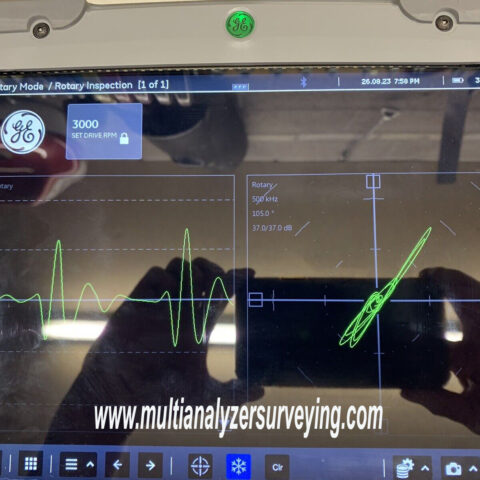
As the D model also includes scanner functionality, it can operate with scanners such as the MiniMite, Spitfire, RA-2000 and PS-5, with supported scanner speeds from approximately 120 to 3,000 RPM.
Why the 600D is valuable
The biggest advantage over the basic NORTEC 600 is dual-frequency/mixing capability. For example, during heat-exchanger tube inspection, one frequency can provide useful defect information while the second helps characterize or suppress unwanted signals. The automatic mixing function is specifically intended to minimize residual signals and improve inspection interpretation.
In short: the NORTEC 600D is a rugged, portable professional ECT instrument aimed particularly at advanced surface inspection and heat-exchanger/tube inspection, where dual-frequency operation and signal mixing provide a significant advantage over a conventional single-frequency eddy-current instrument.
If you’re evaluating a used NORTEC 600D, the next useful step is to check its probe package, software revision, battery condition, calibration status, and included scanner/accessories, since these can substantially affect its practical value.




There are no reviews yet.