
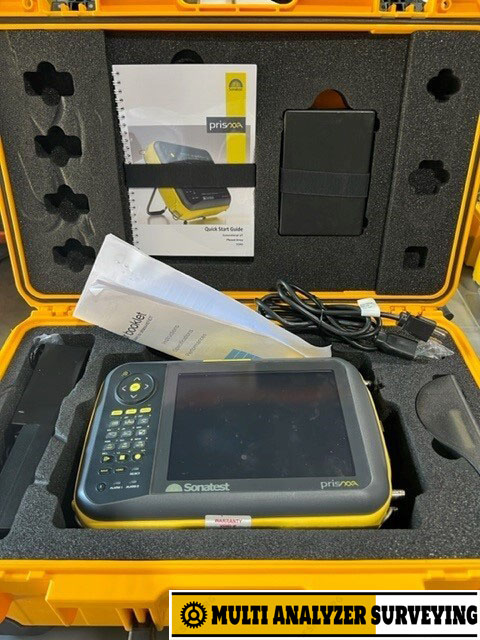
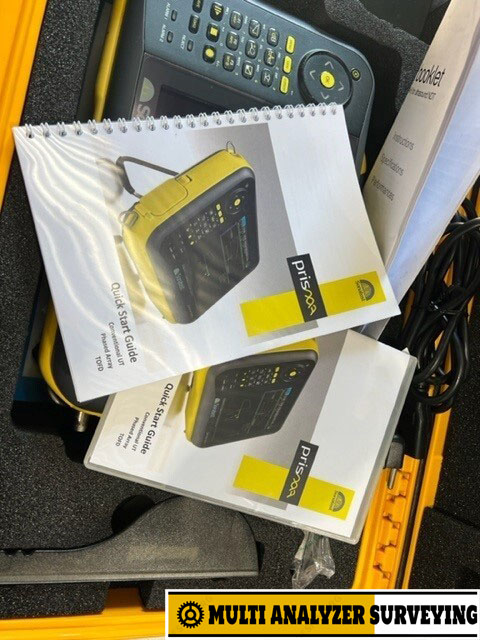
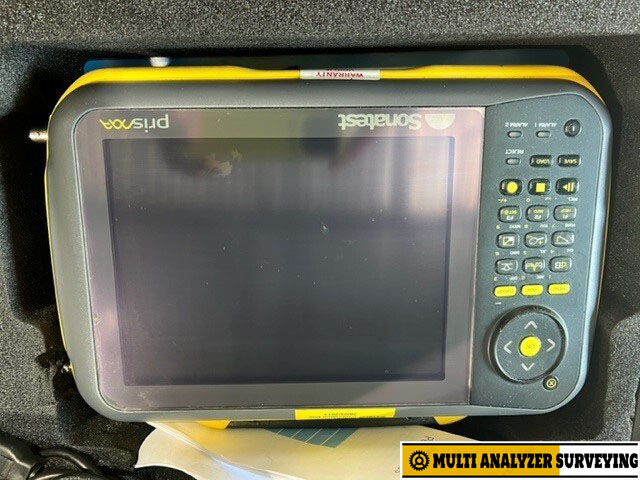
Sonatest Prisma 16:64 Ultrasonic Flaw Detector
Key 16:64 specifications
| Parameter | Prisma 16:64 |
|---|---|
| Phased-array configuration | 16:64 |
| Focal laws | 128 |
| PA channels | 16-channel full digital delay & sum |
| PA test modes | Pulse-Echo, Transmit/Receive |
| PA pulse voltage | -25 to -75 V |
| PRF | 1–5,000 Hz |
| PA bandwidth | 200 kHz–14 MHz |
| Gain | 0–76 dB, 0.1 dB steps |
| ADC | 12-bit |
| Digitizing frequency | 65 MHz |
| Focusing | Natural or constant depth/path/offset |
| A-scan length | Up to 4,096 samples |
| Scan displays | A, B, C, L, S, merged, TOP & END |
| DAC/TCG | 16 points |
| Gates | 4 A-scan gates |
| Data storage | Raw data, files up to 3 GB |
| Encoder | 1- or 2-axis |
| Display | 8.4″, 800 × 600 |
| Battery life | Approx. 6 h in PA mode |
| Weight | Approx. 3.5 kg with battery |
| Environmental | Designed to meet IP66 |
| Operating temperature | -10 to 45 °C |
These specifications are from Sonatest’s legacy Prisma documentation.
What does 16:64 mean?
The 16:64 designation refers to a phased-array architecture capable of using 16 active elements from a 64-element probe/array at a time. The instrument can electronically control the active aperture and delays to generate different focal laws.
The Prisma supports up to 128 focal laws, allowing the operator to electronically steer and focus the ultrasonic beam without mechanically changing the probe angle. This is particularly useful for weld inspections and corrosion mapping.
Main inspection capabilities
1. Phased Array UT (PAUT)
The 16:64 configuration provides electronic beam steering and focusing with S-scan and L-scan visualization.
2. Conventional UT
The Prisma platform also incorporates two conventional UT channels, with A-scan recording and conventional ultrasonic measurements.
3. TOFD
TOFD capability was available as a software option, making the system suitable for weld inspection and crack sizing.
4. Corrosion mapping
With an encoder and suitable PA probe/scanner, Prisma can produce B-scan and C-scan representations for detecting thickness variations and pitting. Sonatest specifically documented Prisma for manual phased-array corrosion investigation.
5. Data analysis and reporting
The system can record raw ultrasonic data and generate PDF reports. UTStudio+ was available for additional analysis, defect measurement and annotation.
Typical applications
- Weld inspection
- Corrosion and erosion mapping
- Pipe and vessel inspection
- Aerospace components
- Composite inspection
- Rail inspection
- Crack, lack-of-fusion and other weld-defect detection
Sonatest’s documentation identifies weld inspection, corrosion mapping, aerospace, composite and rail applications for the Prisma family.
Important point for buying a used Prisma 16:64
Because the Prisma is discontinued, a used unit should be checked carefully.
In particular, verify:
- Whether 16:64 PA software is actually licensed/installed
- PA probe connector and adapter availability
- Battery condition and charger
- Encoder operation
- Touchscreen/display condition
- Availability of UTStudio+
- Software/firmware version
- Calibration and verification status
- Included probes, wedges and scanners
- Whether TOFD is enabled if required
Sonatest lists SW PRISMA PA 16:64 as a specific software option, so a Prisma unit’s physical hardware alone does not necessarily mean it is configured for 16:64 PA operation.
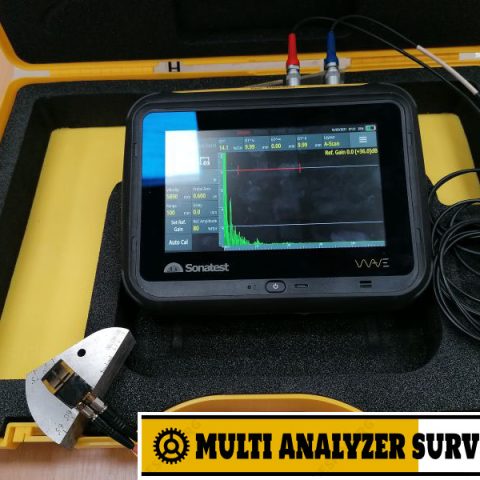
Bottom line: the Prisma 16:64 is a capable older PAUT + conventional UT platform, especially attractive on the used market when supplied with the correct 16:64 license, probes, wedges and scanning accessories. For a new purchase, Sonatest’s current generation has substantially newer capabilities; for example, the current Wave platform offers newer electronics and software.
If you’re evaluating a used Prisma 16:64, the next useful step is to compare its price, condition, included probes/accessories, and software licenses against current PAUT alternatives.


There are no reviews yet.