
Schenck SmartBalancer 4 Field Balancing
How field balancing works
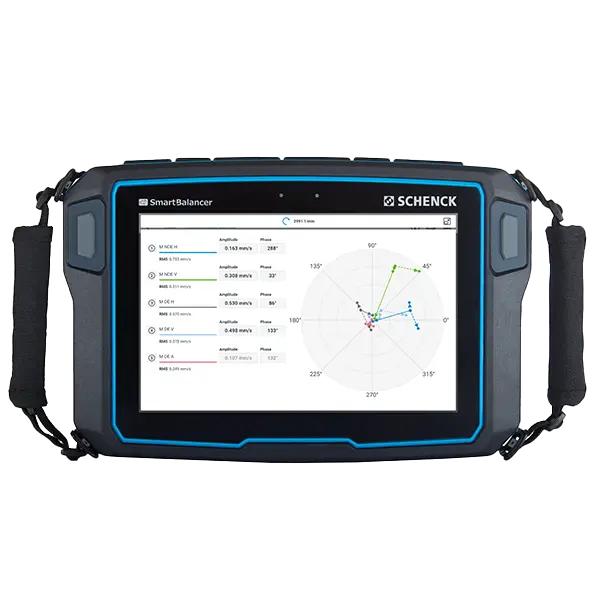
The SmartBalancer 4 uses vibration sensors together with an optical reference signal to determine the amplitude and phase of rotor unbalance. The operator can then perform a trial-weight run, after which the instrument calculates the required correction weight and angular position.
For two-plane balancing, the instrument can determine corrections at two rotor planes, which is useful for longer rotors such as fans, blowers, pumps, compressors, and other rotating assemblies. Schenck specifically supports correction at fixed locations.
SmartBalancing mode
One of the main advantages of the SmartBalancer 4 is its SmartBalancing mode, which combines balancing with vibration analysis. During the balancing process, the operator can view the vibration signal and FFT spectrum, while the instrument guides the balancing procedure.
This makes it more than a simple balancing meter—it can also help investigate whether vibration is actually related to rotor unbalance rather than another machine fault.
Typical applications
- Industrial fans and blowers
- Pumps
- Motors
- Compressors
- Turbines
- Centrifuges
- Gear-driven rotating machinery
- Machine-tool spindles
- HVAC rotating equipment
- Rotors that are difficult or expensive to remove
The major advantage is that balancing can be performed in situ, avoiding removal of the rotor and reducing machine downtime.
Sensors and accessories
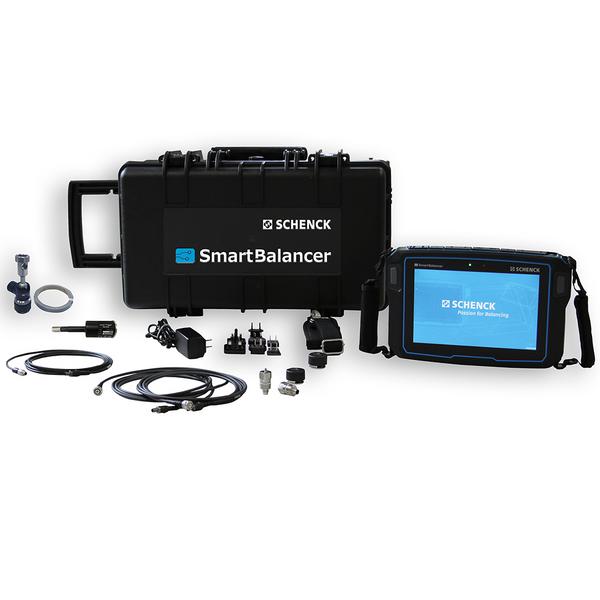
The standard package includes:
- SmartBalancer 4 measuring unit
- 2 acceleration sensors
- Magnetic sensor mounts
- Optical laser reference pickup
- Magnetic laser bracket
- Connection cables
- USB-C PC cable
- AC charger/power supply
- Hard carrying case
A 6-channel upgrade and additional analysis functions are available as options.
Additional vibration analysis
With the appropriate analysis options, the SmartBalancer 4 can perform:
- FFT frequency analysis
- Time waveform analysis
- Phase measurements
- Cross-channel phase
- Envelope spectrum analysis
- Rolling-element bearing assessment
- Gear-condition assessment
- Overall vibration evaluation
The optional Advanced Analyzer module adds envelope-spectrum analysis for detecting periodic impacts associated with bearing and gear damage.
Important safety point
Field balancing involves running rotating machinery with trial weights attached. Schenck’s manual emphasizes securing the work area and ensuring that trial weights cannot detach during operation. Proper machine guarding and operating procedures are therefore essential.
Bottom line
SmartBalancer 4 = portable field balancer + vibration analyzer.
Its strongest features are 120–80,000 rpm operating range, 1- or 2-plane balancing, up to 6 measurement channels, laser phase reference, live FFT analysis, guided balancing, and in-situ rotor correction.
If you’re evaluating it against the Bently Nevada Commtest VB7/VB8, ACOEM Falcon, or Betavib VibWorks LT you’ve asked about, a side-by-side comparison of balancing capability, FFT/diagnostics, channels, sensors, software, and typical applications would be particularly useful.
Key capabilities
| Feature | SmartBalancer 4 |
|---|---|
| Balancing method | 1-plane or 2-plane field balancing |
| Balancing speed | 120–80,000 rpm |
| Measurement channels | 2 standard, expandable to 6 channels |
| Reference | Optical laser reference sensor |
| Vibration measurements | Acceleration, velocity, displacement |
| Analysis | FFT spectrum, time waveform, phase, cross-channel phase |
| Balancing display | Polar/vector display |
| Balancing process | Guided / dialogue-assisted |
| Battery | Li-Ion, 72 Wh |
| Battery operation | At least 8 hours |
| Protection | IP65 |
| Weight | Approx. 2.2 kg |
| Dimensions | 326 × 210 × 56 mm |




There are no reviews yet.