
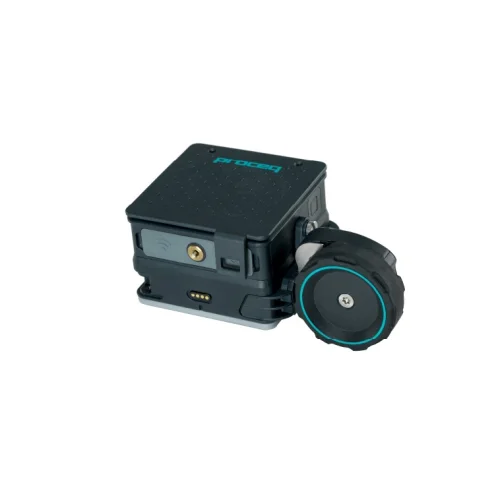
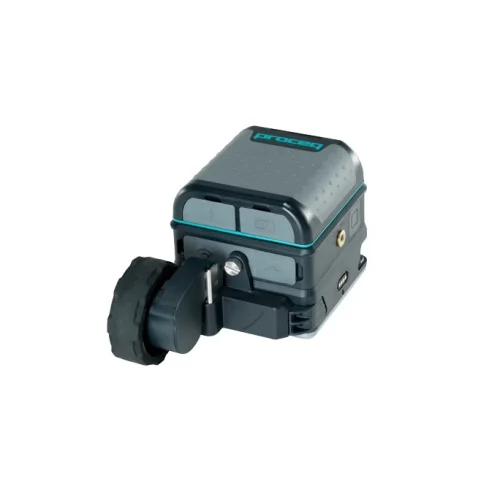
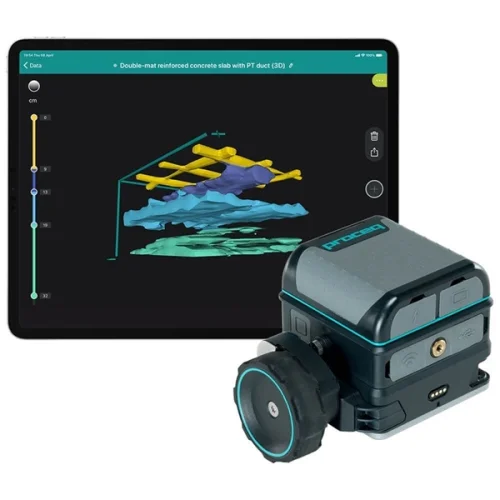
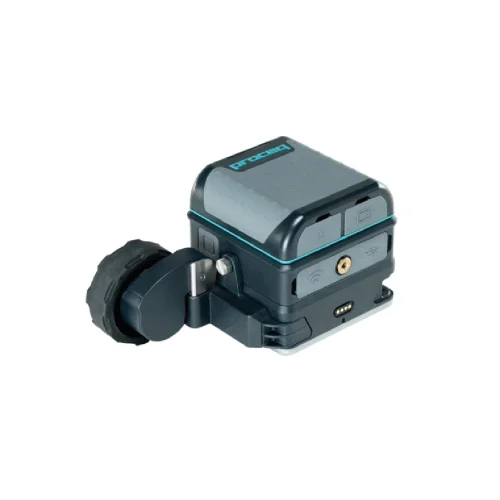
Proceq GP8800 Ground Penetrating Radar Handheld Concrete Scanner
What can it detect?
The GP8800 is intended for locating and investigating embedded features such as:
- Reinforcing bars (rebar)
- Post-tensioning ducts
- Electrical conduits
- Pipes
- Voids and other anomalies
- Congested reinforcement configurations
- Embedded objects close to walls and underneath pipes
It can also assist with slab-thickness measurements, structural investigation and as-built verification.
Main advantage: very compact scanner
The GP8800 is exceptionally small—about 9 × 9 × 7.6 cm and under 0.5 kg without the battery. Its wireless wheel can be configured without tools, and the sensor supports different orientations including cross-polarization configurations. This makes it especially useful for tight or difficult-to-access areas.
Software and visualization
The sensor works with the Proceq GPR App on an iPad. Depending on the software/license configuration, users can work with:
- A-scan
- B-scan / line scan
- Migrated and non-migrated views
- Time-slice visualization
- 3D visualization
- Augmented Reality (AR)
- Area scans
- Automatic logbook and annotations
- Photos, notes and voice annotations
- Report generation
- SEG-Y, JPG, PNG, DOCX and HTML exports
Accuracy
The manufacturer’s documentation specifies ±5 mm depth accuracy after direct dielectric calibration and less than 2% distance error. For closely spaced objects such as rebars, the documented GP8800 separation capability is approximately 3 cm at 5 cm depth. Actual results depend heavily on concrete properties, reinforcement congestion and scanning technique.
GP8800 vs GP8000 vs GP8100
A useful distinction is:
| Model | Frequency | Max depth | Antenna configuration | Best suited for |
|---|---|---|---|---|
| GP8000 | 200–4000 MHz | ~150 cm | Single | Deeper investigations |
| GP8800 | 400–6000 MHz | 65 cm | Single | Compact/tight-area concrete scanning |
| GP8100 | 400–4000 MHz | ~80 cm | 6-element array | Fast large-area scanning |
The GP8800 therefore sits between the deep-reaching GP8000 and the high-productivity array-based GP8100: its main selling point is high-resolution concrete inspection in a very small handheld package.
Bottom line: The Proceq GP8800 is a strong choice for contractors, structural engineers and NDT inspectors who need to locate rebar and other embedded objects without drilling or damaging concrete, especially when access is restricted. Its 400–6000 MHz SFCW radar provides good near-surface resolution, while its tiny form factor makes it considerably easier to use in confined areas than larger GPR systems.
Key specifications
| Specification | GP8800 |
|---|---|
| Radar technology | Stepped-Frequency Continuous-Wave (SFCW) GPR |
| Frequency range | 400–6000 MHz |
| Maximum penetration | 65 cm / 25.6 in |
| Antenna | 1 |
| Antenna-to-edge distance | 4.5 cm |
| Dimensions | 89 × 89 × 76 mm |
| Weight | 487 g excluding battery |
| Connectivity | Wi-Fi / USB-C |
| Battery | Removable 4× AA NiMH pack; Li-ion option also documented |
| Operating temperature | −20°C to +50°C |
| Protection | IP54 reported by distributor specifications |
| Display | Apple iPad running Proceq GPR App |
Specifications are based primarily on Screening Eagle/Proceq documentation and supporting distributor data.


There are no reviews yet.