
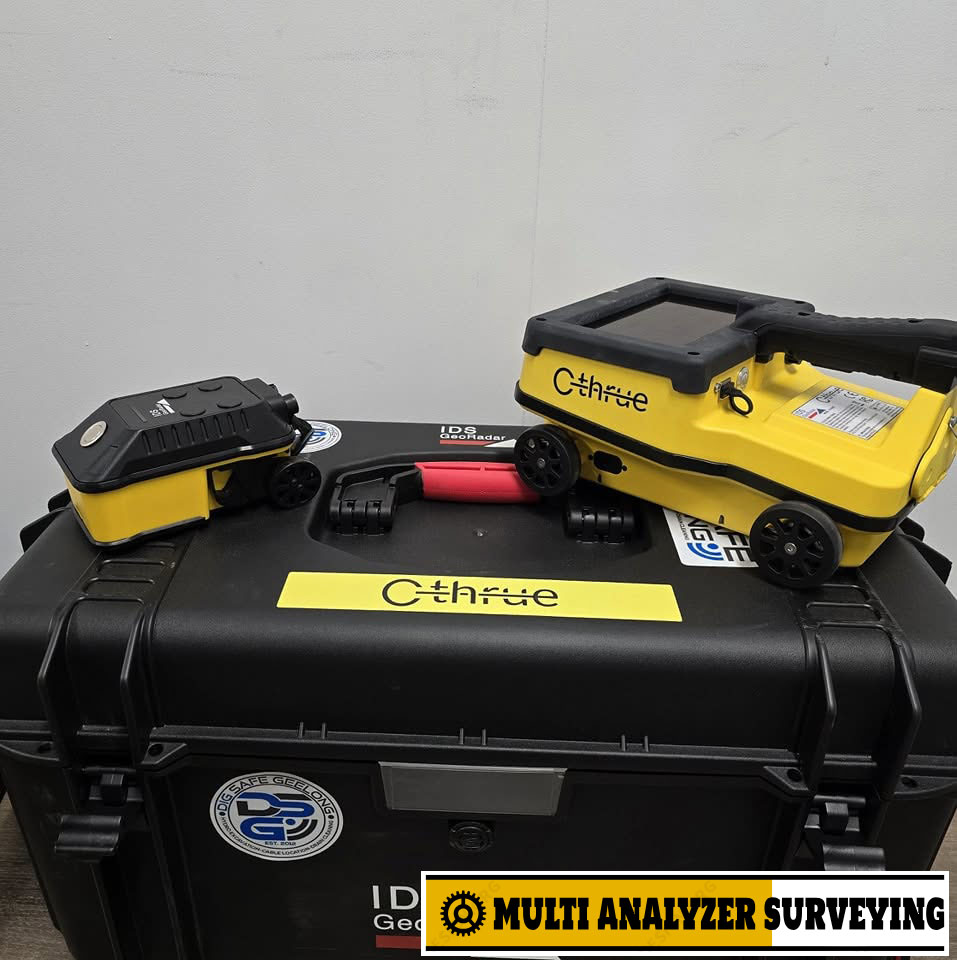
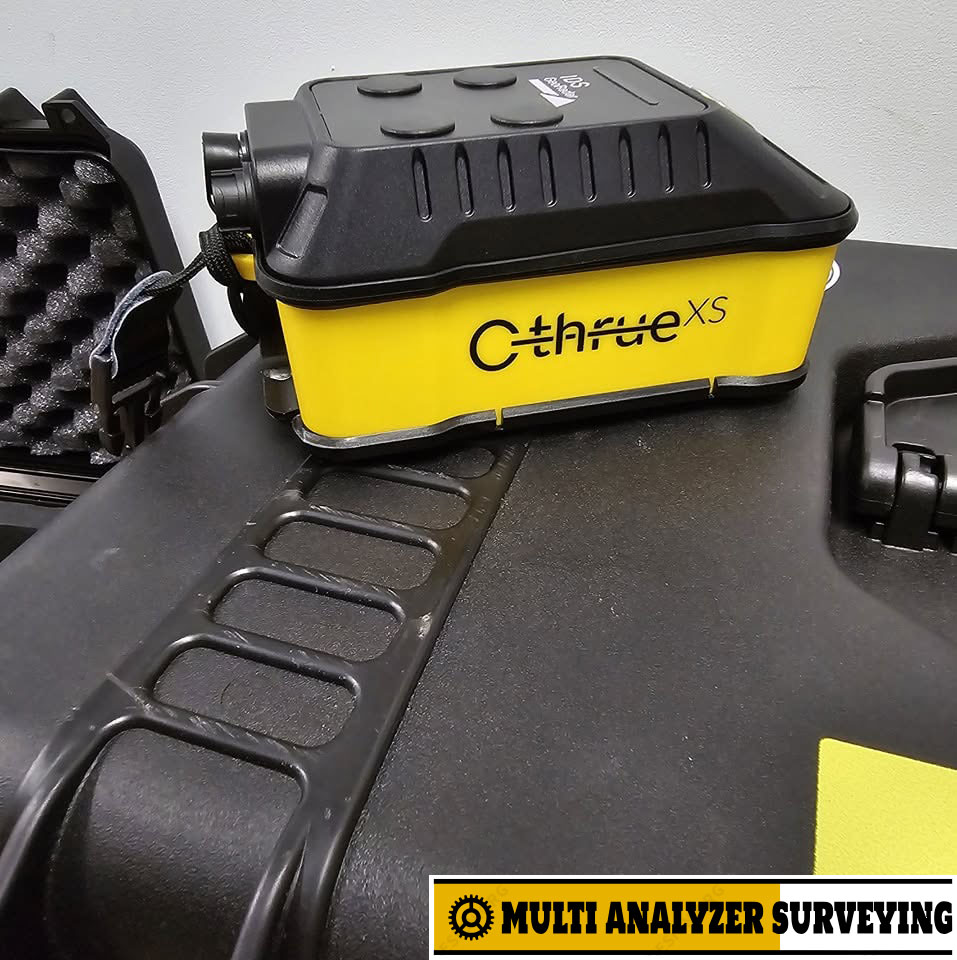
Leica IDS C-thrue Concrete Scanner
Its dual-polarized antenna configuration improves the ability to distinguish reinforcement orientation and subsurface features.
Key specifications
| Specification | C-thrue |
|---|---|
| Radar frequency | 2.0 GHz |
| Antennas | 4 |
| Polarization | Horizontal + Vertical |
| Radar channels | 2 |
| Maximum scan interval | Up to 10 scans/cm |
| Maximum depth | Up to 80 cm / 31.5 in |
| Display | 7-inch TFT multi-touch |
| Scan visualization | B-scan & C-scan/tomography |
| Positioning | VirtualPad / laser-based positioning |
| Power-conduit detection | Integrated EM sensor, 50/60 Hz |
| Battery | 15 V, 3.2 Ah Li-ion |
| Typical runtime | About 3 hours |
| Storage | 32 GB |
| Connectivity | USB, Wi-Fi |
| Weight | 2.4 kg including battery |
| Dimensions | 285 × 200 × 160 mm |
| Environmental rating | IP65 |
| Operating temperature | −20°C to +50°C |
Important features
1. Dual polarization
The four-antenna system uses horizontal and vertical polarization to improve detection of reinforcement and other objects, particularly across different orientations.
2. Real-time B-scan and C-scan
The operator can view radar data immediately, while C-scan tomography provides a more comprehensive view of features inside the concrete.
3. Automatic rebar/void discrimination
The onboard software can automatically assist in identifying rebar and voids, reducing the amount of manual interpretation required.
4. VirtualPad positioning system
Instead of relying entirely on a manually marked grid, the C-thrue uses laser sensors and reflective positioning bars to track the scanner’s position over the concrete surface.
5. Augmented Reality (AR)
With the optional Remote Desktop and AR Kit, scan information can be viewed and shared through an external tablet, which is particularly useful when scanning ceilings, bridge decks, walls, or difficult-to-reach areas.
Typical applications
The C-thrue is particularly useful for:
- Concrete drilling and coring preparation
- Rebar mapping before cutting
- Bridge and overpass inspection
- Building renovation
- Tunnel inspection
- Concrete slab investigation
- Locating PT cables before drilling
- Detecting embedded conduits
- Finding voids/cavities
- Comparing actual construction with engineering/as-built information
Leica specifically positions it for buildings, bridges, tunnels, overpasses, monuments and renovation work.
Software
The C-thrue provides onboard real-time processing, feature marking, automatic first-layer rebar detection, job reporting and B/C-scan visualization.
For more advanced post-processing, IDS GeoRadar NDT Reveal is Leica’s CAD-based software for analyzing C-thrue and C-thrue XS data. It is intended to integrate concrete GPR inspection data with CAD/project workflows.
C-thrue vs. a basic rebar locator
The main distinction is that the C-thrue is a GPR imaging system, rather than simply a magnetic/electromagnetic rebar locator. It can produce subsurface radar images and investigate significantly deeper structures—up to 80 cm under favorable conditions—while also identifying features such as voids and PT cables.
Bottom line: The Leica IDS C-thrue is aimed at professional non-destructive concrete investigation, especially where knowing the location and depth of reinforcement, PT cables, conduits and voids is important before drilling, cutting or structural work.
If you’re evaluating one for purchase, the next useful step is a C-thrue vs. Proceq GP8100 comparison—especially depth, antenna technology, software, accuracy and typical used-market value.





There are no reviews yet.