
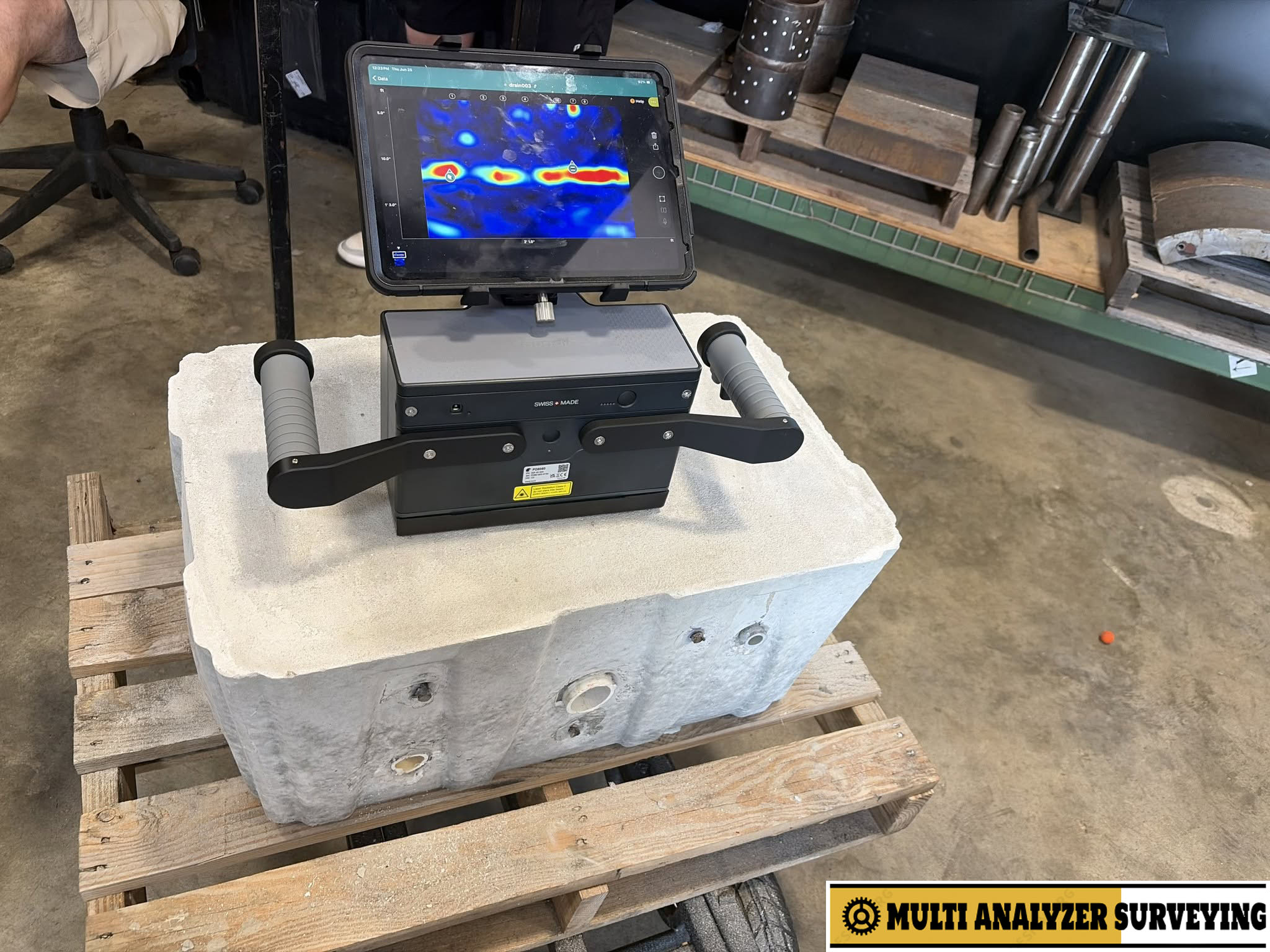
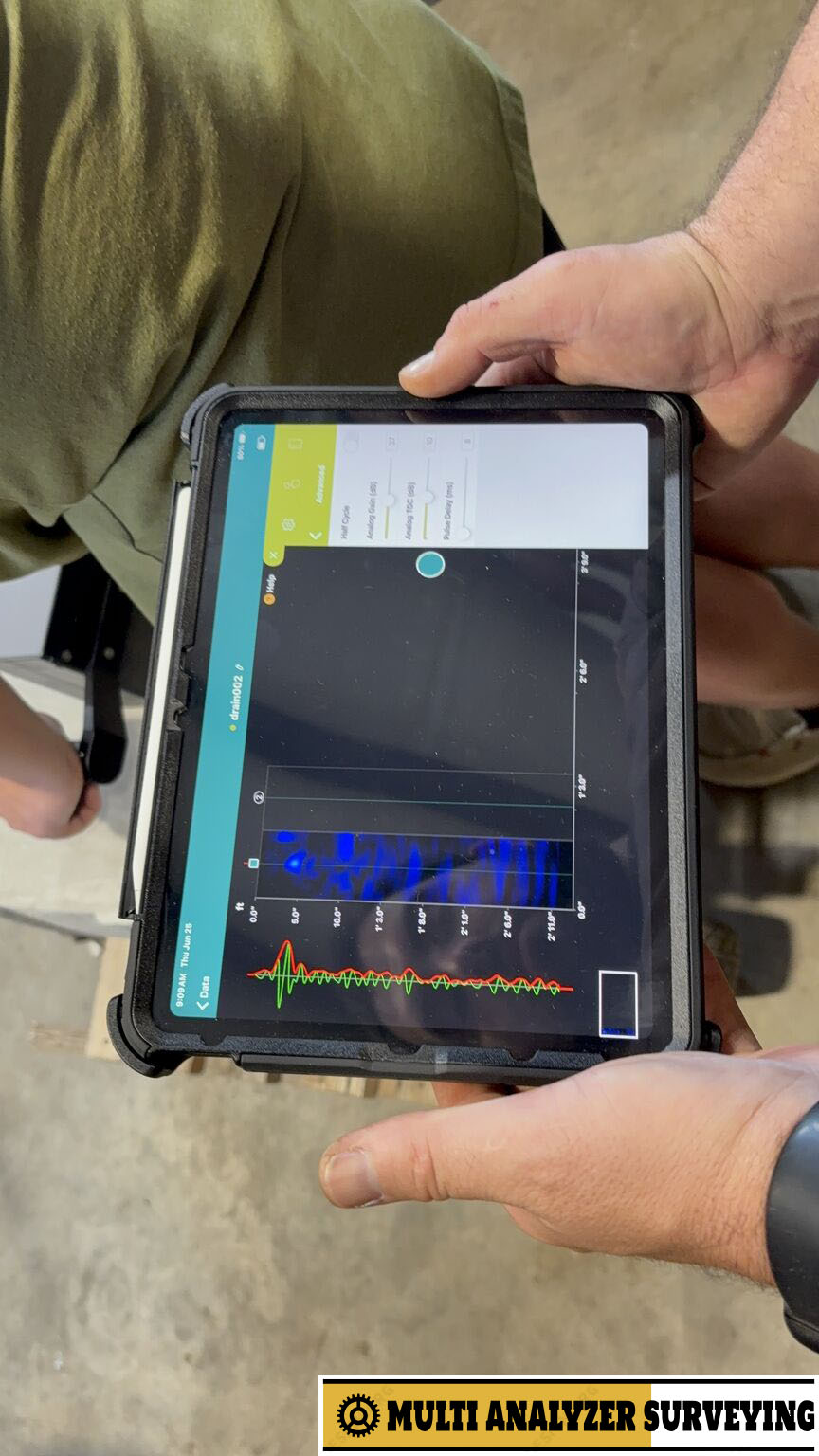
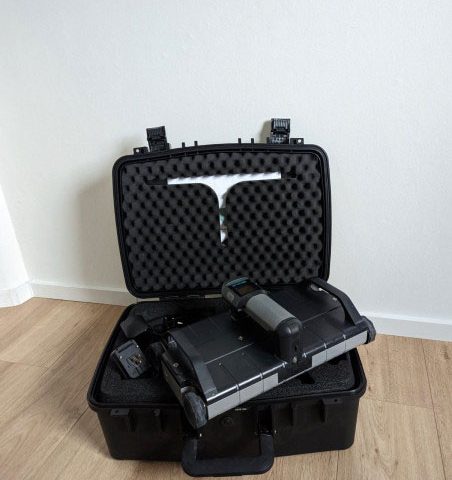
Proceq Pundit PD8050 Ultrasonic Pulse and Echo
What it is used for
The PD8050 can be used for:
- Void and delamination detection
- Honeycombing detection
- Concrete thickness measurement
- Detection/imaging of reinforcing bars
- Bonding assessment
- Detection of poorly grouted ducts and other subsurface anomalies
- Concrete homogeneity and pulse-velocity assessment
- Inspection of fiber-reinforced concrete
- Avoiding accidental drilling/coring into embedded objects
How it works
Unlike conventional ultrasonic through-transmission testing, the PD8050 places the transmitting and receiving transducers on the same surface.
The ultrasonic pulse travels into the concrete and reflects when it encounters boundaries or objects having different acoustic impedance—for example:
Concrete → void → rebar → honeycomb → back wall
The reflected signals are processed to produce an image of the internal structure. The instrument uses an array of 24 transducer elements arranged in 3 rows × 8 columns, forming 8 channels in its standard configuration.
Key specifications
| Specification | PD8050 |
|---|---|
| Technology | Multi-channel ultrasonic pulse echo |
| Frequency bandwidth | 20–80 kHz |
| Pulse voltage | ±50 to ±150 V |
| Receiver gain | 1–10,000 / 0–80 dB |
| Measuring resolution | 1 µs |
| Typical measuring range | Up to 2 m / 6.6 ft, depending on concrete |
| Measurement modes | Line, stripe, grid scan |
| Review modes | A-scan, B-scan, C-scan, heat maps |
| Display | Compatible Apple iPad |
| Connection | Encrypted Wi-Fi / USB-C options |
| Battery | 6 × AA NiMH battery pack |
These specifications are from the manufacturer’s documentation; actual penetration depends strongly on concrete quality and the object being inspected.
Imaging capabilities
One of the PD8050’s major advantages is that it is more than a simple ultrasonic thickness meter. It can generate:
A-scan → individual ultrasonic signal/waveform
B-scan → cross-sectional/line image
C-scan → time-slice representation
Heat map → depth or pulse-velocity visualization
3D view → volumetric representation of scanned areas
It also supports AR visualization and AI-assisted positioning/feature interpretation through its software ecosystem.
Depth-of-field settings
The system allows the operator to optimize the ultrasonic transmission for different depths. For example:
- Near field: approximately 0.5–0.6 m
- Intermediate field: approximately 1.2–1.3 m
- Far field: approximately 2.2–2.4 m under suitable conditions
The far-field setting uses lower frequency and higher transmission voltage to improve penetration.
8-channel vs. 16-channel
The standard system uses 8 channels. A 16-channel configuration is available and increases the amount of ultrasonic information acquired during a scan. The manufacturer notes that the 16-channel arrangement is particularly useful for very deep objects.
PD8050 vs. concrete GPR
The PD8050 is especially interesting when compared with a concrete GPR, such as the Proceq GP8100:
| Feature | PD8050 Ultrasonic | Concrete GPR |
|---|---|---|
| Main principle | Ultrasonic pulse echo | Electromagnetic radar |
| Rebar detection | Excellent | Excellent |
| Voids/delamination | Very useful | Useful, depending on conditions |
| Deep defects below rebar | Strong advantage | Can be limited by dense reinforcement |
| Concrete thickness | Yes | Yes, under suitable conditions |
| Moisture sensitivity | Significant | Significant |
| Imaging | 2D/3D/heat maps | 2D/3D |
| Best application | Internal concrete integrity | Rebar/embedded-object mapping |
A major advantage of ultrasound is that signals can continue beyond reinforcing steel, whereas dense reinforcement can substantially interfere with GPR penetration. Screening Eagle specifically highlights this advantage for detecting defects below rebar grids.
In short: the PD8050 is a high-end concrete imaging NDT instrument, particularly valuable when the objective is not merely finding rebar but determining what is happening inside the concrete—voids, delamination, honeycombing, thickness, ducts, and structural defects.
If you’re evaluating one for purchase or used-equipment resale, the next useful step would be a PD8050 complete specification + accessories + typical used/new market price + comparison with GP8100.


There are no reviews yet.