
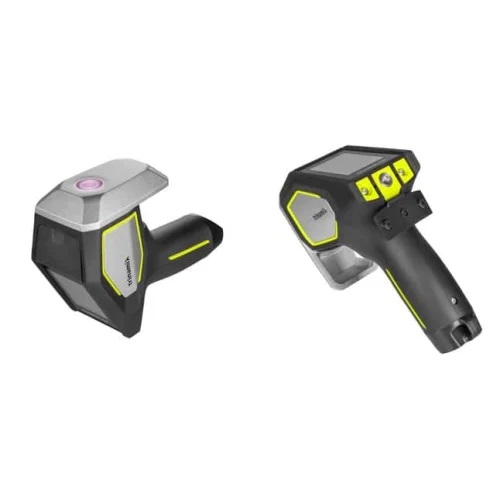
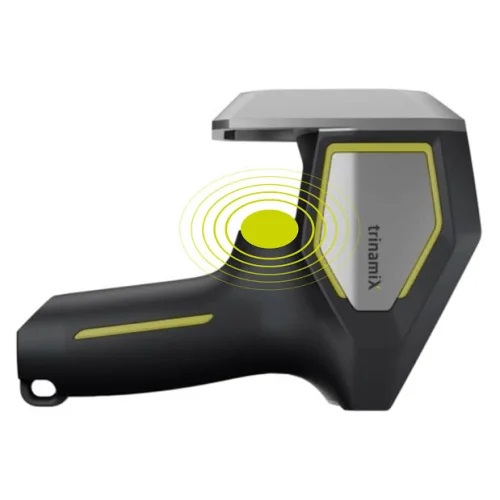
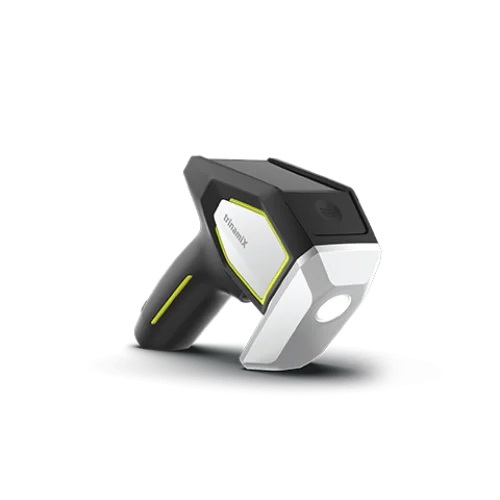
TrinamiX PAL Two next-generation mobile handheld spectrometer
Key specifications
| Feature | PAL Two |
|---|---|
| Technology | Near-infrared spectroscopy |
| Spectral range | 1,300–2,350 nm |
| Detector | 128-pixel PbS line-array detector |
| Optics | Grating technology, no moving parts |
| Scan spot | 50 mm² |
| Spectral resolution | <50 nm |
| Light source | 12 tungsten-halogen lamps |
| Protection | IP65 dust/water resistant |
| Dimensions | 180 × 124.5 × 70 mm |
| Weight | About 700 g |
| Display | Built-in display |
| Connectivity | Bluetooth to smartphone/tablet |
| Analysis | trinamiX cloud/software ecosystem |
The manufacturer’s current technical documentation specifies the 1,300–2,350 nm range, 128-pixel PbS detector, 12-lamp source and IP65 housing.
What can it be used for?
The interesting part is that PAL Two is a hardware + software system, rather than simply a spectrometer.
Typical applications include:
- Plastic identification and sorting — PET, HDPE, LDPE, PP, PVC, PS, PA, ABS, PC, PLA and others.
- Textile identification
- Recycling and incoming-material inspection
- Agriculture/feed analysis
- Quality control and spot checks
- Analysis of heterogeneous materials, with an optional PAL Two Rotator for samples such as feed and forage.
For example, in plastics recycling, the instrument measures the NIR spectrum of a plastic object and the application interprets that spectrum to identify the polymer. trinamiX offers ready-to-use applications rather than requiring every user to build their own chemometric model.
How the system works
The workflow is roughly:
PAL Two → Bluetooth → trinamiX Guide App → cloud analysis → result
You connect the spectrometer to a smartphone/tablet using the trinamiX Guide App, select the relevant application, perform the scan, and receive the interpreted result. Data and reports can then be managed through the Customer Portal.
An important limitation is that the PAL Two can measure offline, but the analysis/results are calculated in the cloud, so an internet connection is required to see results for applications that use cloud processing.
Why it is interesting
The main advantage is portability without abandoning relatively sophisticated NIR analysis. Instead of taking a material sample to a benchtop instrument, an operator can potentially identify or assess it directly at the point of inspection.
trinamiX emphasizes three characteristics:
Versatile — broad 1,300–2,350 nm spectral range and applications across industries.
Robust — IP65 enclosure and optics with no moving parts.
Convenient — handheld, one-handed operation and immediate display of measurement results.
One caveat: despite marketing language about performance approaching benchtop systems, PAL Two isn’t a universal replacement for a laboratory spectrometer. It is intended for defined applications, and its official manual explicitly excludes medical, safety-critical, explosive-area and certain hazardous-material applications.
Official trinamiX PAL Two product page
If you’re evaluating it for plastic recycling, food/feed analysis, pharmaceuticals, textiles, or your own material-identification application, I can also break down exactly what the PAL Two can detect, its accuracy/limitations, price, and alternatives such as handheld FTIR/NIR/Raman instruments.



There are no reviews yet.